Highlights from BVU’s 2025 Nonprofit Pulse Survey
Each month, BVU’s Nonprofit Pulse Survey gathers insights from nearly 500 nonprofit chief executives across Northeast Ohio. The 2025 results paint a clear picture of a sector navigating sustained financial, strategic, and operational uncertainty – just as demand for services continues to grow.
Across organizations of all sizes and missions, leadership capacity and governance are under strain at a moment when strong leadership matters most.
Four key themes emerged:
Financial Volatility Is Stress-Testing Nonprofits
Funding declines are widespread and happening at the same time across multiple sources.
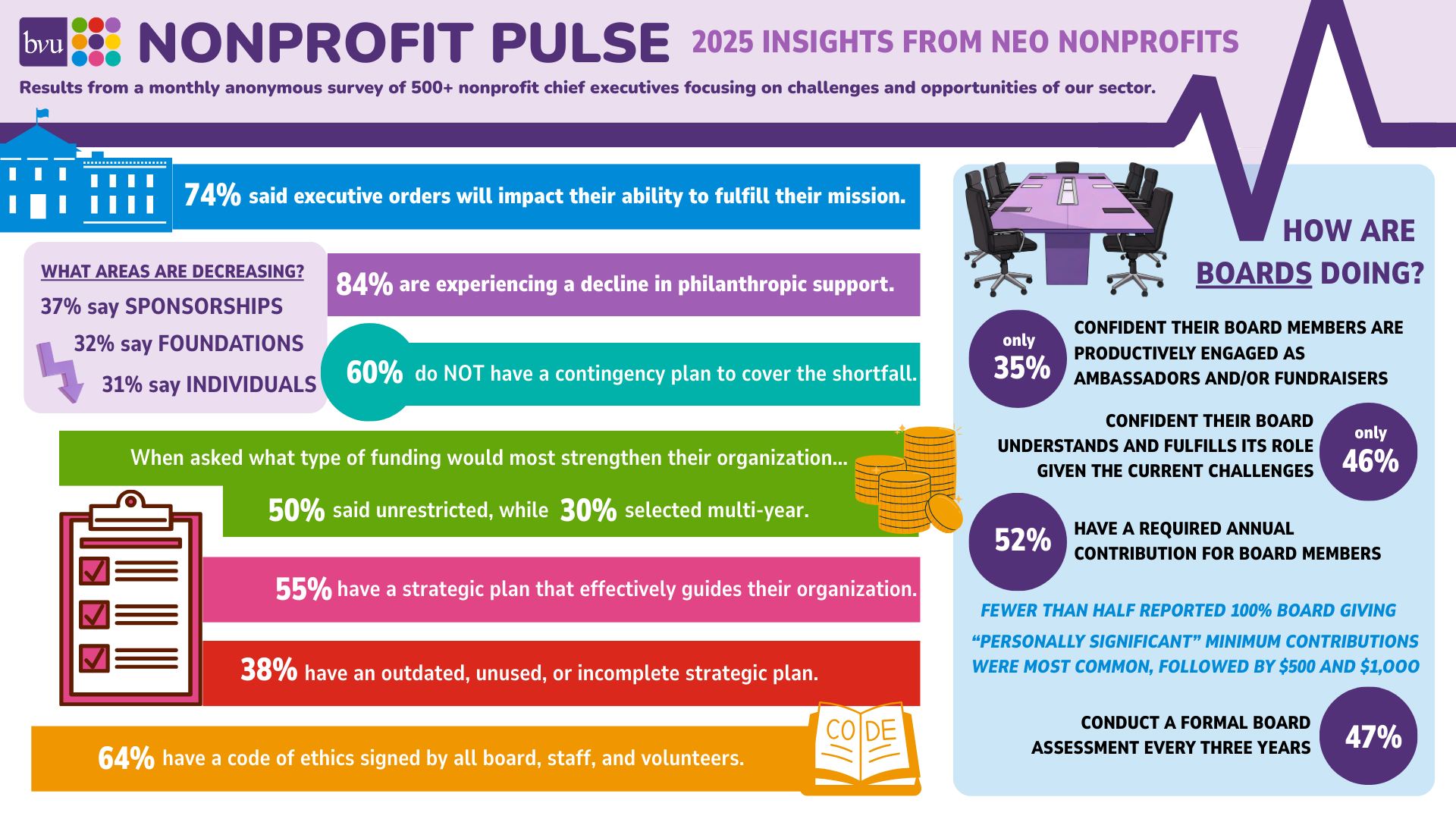
Overall, 84% of nonprofit leaders report a decrease in philanthropic support, including reduced sponsorships (37%), foundation funding (32%), and individual giving (31%).
At the same time, 74% say recent executive orders will impact their ability to fulfill their mission.
For many organizations, even modest shortfalls raise the real possibility of staff or program cuts, and 60% report they do not have a contingency plan in place.
Leaders shared:
“If we can’t cover the shortfall, we will most likely cut staff & programs.”
“With all the uncertainty at the federal and state levels, it would be helpful if foundations could just provide general operating support.”
“We are raising as we are spending. It would be great to have unrestricted or capital support to get a year ahead in spending and fundraising as a sustainability strategy.”
These local realities mirror national trends, where nonprofit leaders are also reporting rising demand for services, operating deficits, and ongoing cost pressures.
This local reality mirrors what nonprofit leaders are reporting nationally. In the Nonprofit Finance Fund’s State of the Nonprofit Sector Survey 2025 survey of nonprofit leaders, 85% reported they expect increased demand for services this year, with many ending 2024 with operating deficits (36%) and facing inflation-related cost pressures that stretch budgets and cash reserves.
In an Urban Institute report on nonprofit concerns, nonprofit leaders nationally described financial instability tied to uncertain revenues and rising expenses. They emphasized the challenges of sustaining operations in a shifting funding landscape, reinforcing what local leaders report through BVU’s Nonprofit Pulse.
Many Organizations Lack a Clear Strategic Compass
In today’s environment, a strong strategic plan is essential, yet preparedness varies.
While 55% of nonprofit leaders say they have a strategic plan that effectively guides their organization, 38% report their plan is outdated, unused, or incomplete. Without a shared roadmap, many organizations are left reacting rather than leading.
Leaders noted:
“We’ve been having proactive strategy sessions, which has helped, but it’s clear not all board members feel comfortable in that role yet.”
“Our board is supportive, but they need more guidance on how to lead during uncertainty.”
Boards Are Critical, but Engagement Is Uneven
Boards remain one of nonprofits’ most important assets, yet engagement and readiness vary widely.
Only 35% of nonprofit leaders are confident their board members are productively engaged as ambassadors and/or fundraisers, and just 46% feel their board fully understands and fulfills its role given current challenges.
While 52% of nonprofits require annual board contributions, fewer than half achieve 100% board giving. And only 47% conduct a formal board assessment every three years.
Leaders shared:
“Some board members step up, others step back. We need more consistency.”
“Board members want to help, but they need the knowledge and tools to do so effectively.”
When asked where boards make the greatest impact beyond financial contributions, 46% pointed to championing the mission and serving as ambassadors – far more than providing expertise or resources.
Again, this local experience reflects national trends. Reporting from The Chronicle of Philanthropy notes that boards are more important than ever as nonprofits navigate financial and political uncertainty, yet uneven engagement, particularly around fundraising and strategic leadership, continues to limit organizational effectiveness.
Similarly, BoardSource Best Practices (2025) emphasizes that clearly defined roles, active participation, and ongoing board education are essential to improving board performance and impact.
Funding Flexibility, Capacity, and Trust Drive Sustainability
When leaders talk about what would strengthen their organizations most, the message is consistent:
- 50% say unrestricted funding would have the greatest impact
- 30% value multi-year funding most
As one leader put it:
“Without a strong foundation, programs cannot thrive.”
Others emphasized the need for trust and flexibility:
“Metrics and numbers are only part of the story.”
“If I could wave a magic wand, nonprofits would have unrestricted, multi-year support to enable strategic growth.”
Moving Forward Together
The takeaway is simple but important: nonprofit leaders are doing everything they can to meet growing community needs while navigating financial pressure, strategic uncertainty, and governance challenges.
This is where BVU’s work is focused: listening to nonprofit leaders, strengthening boards and executive leadership, and connecting businesses and community partners to the organizations that anchor our region.
Strong governance, clear strategy, and engaged boards aren’t optional. They are foundational to sustainability and impact.
We’re grateful to the nonprofit leaders who continue to share their experiences through BVU’s Nonprofit Pulse Survey and help guide stronger solutions for Northeast Ohio.
Equip boards, chief executives, and staff to lead with confidence. Contact us today to get firsthand knowledge and expertise.